
According to prevailing oral traditions and indigenous historical accounts, the origin of Meitei kingship traces back to a boy of uncertain parentage whose father’s identity remains shrouded in mystery. It is said that the boy descended from the Naga Hills following the course of a river that led him into the fertile valley plains. There, plausibly, he grew up among the Chothe Nagas and gradually integrated into the valley community.
Through his leadership and alliances, he consolidated neighboring settlements, bringing them under a single political framework. His coronation as Nongda Lairen Pakhangba in 33 CE marked the beginning of the Ningthouja dynasty, which established hegemony over the Seven Clans (Salais): Angom, Chenglei, Khuman, Khaba-Nganba, Luwang, Moirang, and Ningthouja. This consolidation laid the foundations of a centralized polity that evolved into the Kangleipak kingdom.
The later introduction of “Vaishnavism” under Bengali influence further entrenched a caste-based hierarchy and reoriented the valley polity toward the broader Hindu cultural sphere. While these developments reinforced administrative centralization, they also initiated a historical divergence between the hill and valley societies – the effects of which still echo today.
In contrast, the Naga-inhabited hills developed autonomous, egalitarian village republics, with decision-making rooted in community consensus. These “dual historical trajectories”-centralized monarchy in the valley and decentralized democracy in the hills-defined Manipur’s early socio-political evolution. During British colonial rule, this reality was formally institutionalized through “dual administration”, which separated the governance of the hills and the valley while maintaining their interdependence.
The end of World War II ushered in global ideals of freedom, equality, and popular consent in governance. Against this backdrop, Manipur undertook a brief yet remarkable experiment in Constitutional Monarchy and Representative Self-Rule with the Manipur State Constitution Act of 1947. The Act created a bicameral framework with the Maharaja as constitutional head and an elected Manipur State Assembly. The first election in 1948, though boycotted by the Naga communities, produced a government led by the Manipur State Congress – an early attempt to reconcile hill and valley interests within a single political order.
However, this democratic experiment was short-lived. In September 1949, under intense national pressure, Maharaja Bodhachandra Singh signed the “Merger Agreement” with the Government of India at Shillong – without consulting either the hill or valley representatives. The agreement, viewed by many as an act of betrayal, resulted in Manipur’s formal integration into the Indian Union on 15 October 1949 and the abrogation of its constitution. The episode left a deep imprint on collective memory, breeding enduring “distrust and alienation” among the hill communities toward the valley-based political leadership.
The divide between Manipur’s hill and valley communities deepened after the North-Eastern Areas (Reorganisation) Act, 1971 came into force in January 1972, along with the insertion of Article 371-C in the Constitution. Although Article 371-C formally acknowledged the historic ethnic, linguistic, cultural, and territorial diversity of these communities – and implicitly recognized the British-era system of dual administration – its practical effect remained largely symbolic. Administrative centralization and majoritarian dominance progressively subsumed the distinct political identities of the hill regions within valley-centric state institutions, thereby exacerbating existing fault lines rather than resolving them.
Understanding why the term “Hill Areas” appears in Article 371-C and why the provision was crafted specifically for Manipur requires attention to historical and constitutional context. Article 371-C is not arbitrary; it reflects the long-standing existence of two historically distinct socio-political entities-the Hill communities and the Valley community-whose separate identities and governance systems predate British rule and persisted under British Manipur’s dual administrative structure. Even though the North-Eastern Areas (Reorganisation) Act, 1971 later reconfigured the political landscape by consolidating power in favour of the majority community, Article 371-C remains a constitutional affirmation of the dual historical communities and their respective political rights.
Recent efforts to characterize the Hill peoples merely as “tribal populations of Manipur,” with the aim of placing them under the Autonomous District Councils or bringing them within the ambit of the Sixth Schedule, are neither historically grounded nor constitutionally tenable. Articles 370, 371, and 371-A to 371-J were never intended as routine administrative provisions; they serve India’s nation-building project by extending democratic safeguards to communities with distinct political histories, cultures, and geographies- many of whom were not part of India at Independence. While the Sixth Schedule offers autonomous governance for tribal groups across the North East generally, provisions such as Articles 371-A, 371-B, 371-C, 371-F, 371-G, and 371-H address specific historical and political contexts of particular states or regions. Within this framework, Article 371-C functions as a tailored constitutional mechanism recognizing the unique historical and political rights of the Hill peoples of Manipur; it cannot be substituted by the broader, more general intent of the Sixth Schedule.
As a result, the concentration of state institutional power in the hands of a single community (the Valley people), compounded by New Delhi’s failure to protect and operationalize Article 371-C, has served not as an instrument of integration but as a mechanism that reinforces historical divisions and sustains the collective memory of marginalization and “BETRAYAL BY THE MODERN INDIAN DEMOCRACY”. Socio-psychological theories indicate that inherited memory, transmitted across generations, strengthens intergroup mistrust. This enduring “Collective Memory” of subjugation and betrayal among the Hill communities persists across time and circumstances. Consequently, the Hill people perceive laws and policies emanating from the Manipur government or from New Delhi – regardless of their objective intent – through a lens shaped by historical grievances. The persistent failures of the state in governance, public service delivery, and equitable development and New Delhi’s indifference to Article 371-C have further validated Hill Communities’ perceptions of bias and betrayal. This entrenched mistrust constitutes the psychological and political foundation for recurring tension and sporadic ethnic violence.
Meanwhile, developmental stagnation in the hills has led to a population surge, whereas the valley’s relative progress has produced demographic stabilization. This uneven demographic pattern-exacerbated by the alleged influx from across the Myanmar border-has intensified insecurity and ethnic anxieties. Corruption, narcotics, and illicit arms trade have flourished in this governance vacuum, enriching select groups from both the hill and valley regions. Even elements within the security establishment and state police have been complicit and found involved in such activities. These dynamics have facilitated an unchecked “influx of illegal immigrants and black-market actors”, particularly in the valley, posing not only economic challenges but also “demographic threats” to the indigenous valley population.
The Naga national movement for self-determination, which declared independence on August 14, 1947, continues to influence political perceptions in Manipur. For many in the valley, it symbolizes the unresolved question of territorial integrity, while for the Nagas, it represents a continuation of their historical struggle for Self-determination. The result is a perpetuation of mutual suspicion, complicating every attempt at reconciliation between hill and valley.
Therefore, any meaningful attempt to address Manipur’s recurring crises must move beyond ad hoc peace negotiations and superficial administrative remedies. A genuine problem-solving approach requires confronting the historical roots of mistrust, the socio-psychological dimensions of identity, and the structural failures of governance that have perpetuated division. Rebuilding trust demands transparent governance, equitable development, and above all, a genuine federal framework that empowers both the hill and valley regions based on modern democratic principle to manage their internal affairs equitably- through autonomy, mutual respect, and robust institutional mechanisms – rather than perpetuating a one-sided, centralized authority emanating from Imphal or Delhi. Such an approach must aim to restore confidence among the hill communities while safeguarding the valley’s demographic and cultural integrity.
Therefore, challenge before Manipur is not only political; it is profoundly psychological, ethnic and historical. Only by acknowledging and addressing this layered legacy can the state hope to heal its enduring divides and move toward a sustainable peace founded on justice, inclusivity, and shared belonging.
About the Author: KH. Pou, PhD, is an Assistant Professor at the University of Delhi and also serves as Editor-at-Large at ICNA. View all articles by the author.
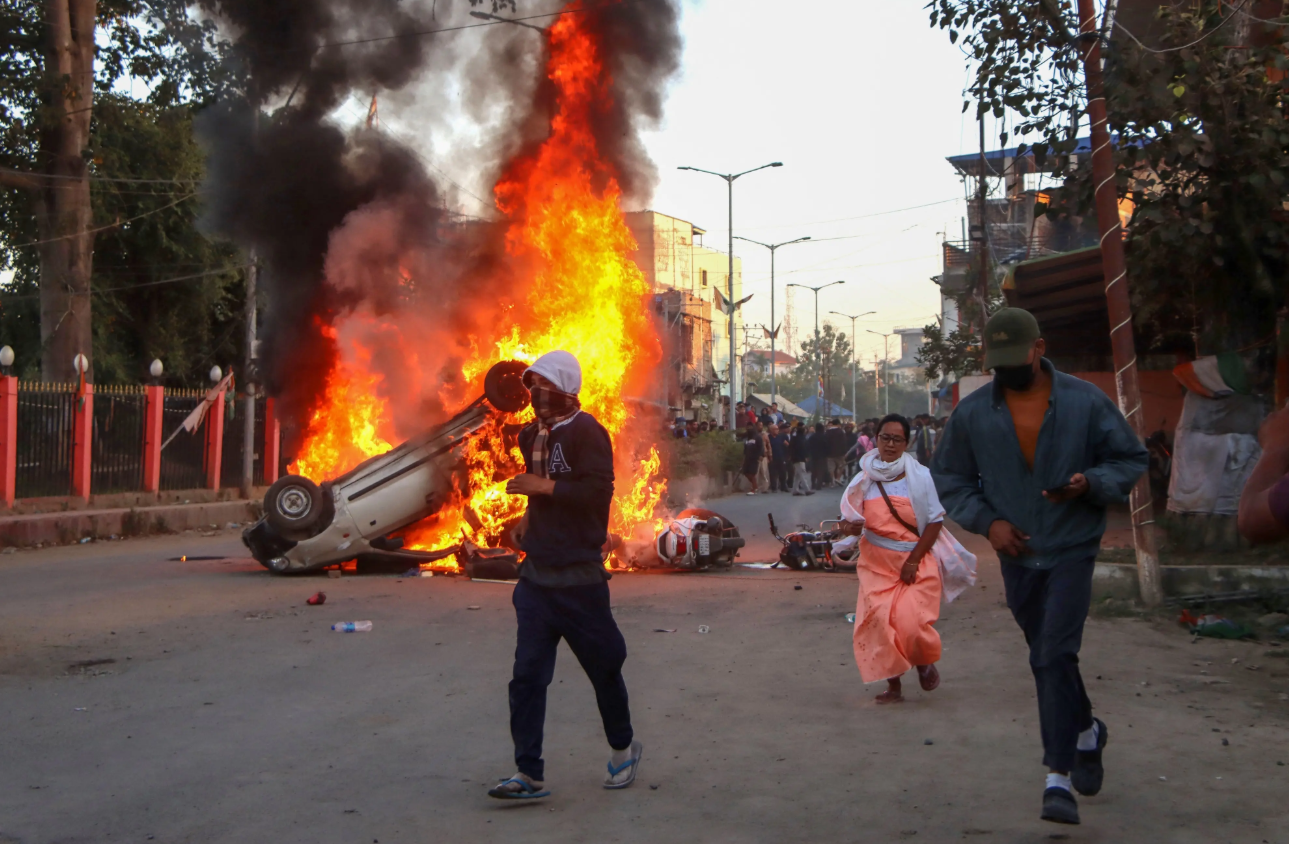
Featured Image: People run past burning vehicles of India’s Bharatiya Janata Party (BJP) during a protest to condemn the alleged killing of women and children in Imphal, capital of India’s northeastern state of Manipur, November 16, 2024. © 2024 AFP via Getty Images
ICNA reserves all rights to the content submitted. The author’s views are their own and do not necessarily reflect those of icna.nl